News
2026/07/29
Future Forward: Why Singapore remains the ideal business hub for ASEAN and global expansion in 2026
Hello from Zero-Ten Park Singapore, the best serviced office and co-working space in CBD Singapore!
As an emerging economic powerhouse, Southeast Asia is a wealth of untapped consumer market with a combined GDP of approximately $4.42T and a population exceeding 680 million — larger than the European Union according to IMF data. Among them, Singapore has the second highest GDP of $606.23B as of early 2026, with the highest GDP per capita, a whopping $99,042. According to a World Economic Forum report on ASEAN, Southeast Asia will add about 140 million new consumers by 2030. By then, about 1 in 6 consumer households globally will be in Southeast Asia. Income levels will grow annually by 6% – 8% in emerging ASEAN, creating economies powered by the middle class.
Not only does ASEAN have growing spending power, it provides manufacturing diversification away from China. Vietnam has emerged as a major electronics and textile exporter, with Samsung’s largest factory complex in the world located near Hanoi. Indonesia is developing a nickel and EV battery supply chain. Thailand is Southeast Asia’s automotive hub. The Philippines is a successful business process outsourcing (BPO) industry. Malaysia and Singapore are key nodes in the global semi-conductor supply chain, with Singapore producing about 1 in every 10 chips worldwide and accounts for around one-fifth of global semiconductor equipment output. (Source: CNA)
As tensions linked to a Hormuz blockade extend beyond the Middle East, highlighting vulnerabilities in critical global shipping routes, the Strait of Malacca has been placed in the spotlight. The Strait of Malacca, which connects the Indian Ocean and the South China Sea, carries a significant share of global trade and energy shipments, making it one of the world’s most strategically important maritime corridors. Singapore and Indonesia have recently pledged to keep the Strait of Malacca open, safe and accessible to all, elevating maritime security to the forefront of a bilateral relationship that both countries increasingly see as critical to regional stability and economic growth.
ASEAN’s young demographics (median age ~30), rising middle class, and rapid digital adoption make it one of the most attractive regions for long-term investment. Countries such as Malaysia, Indonesia, Vietnam, and Thailand have been actively attracting foreign investment. Yet, despite higher operating costs especially impacted by current world affairs, Singapore continues to stand out as the preferred base for business incorporation and regional headquarters.
In this article, we briefly cover key reasons why Singapore continues to be a trusted hub for global companies looking to expand and innovate.
1. Political, Regulatory and Fiscal Stability
Amid geopolitical tensions and market volatility, Singapore’s political, regulatory and fiscal stability has been highly sought after. Singapore’s strong rule of law, highly effective public institutions, transparent regulation and consistent enforcement has led to a long track record of political and economic stability.
In contrast, some markets in the region may experience frequent regulatory changes, unclear enforcement, or administrative delays that create uncertainty for businesses. Expropriation and nationalization, political violence and civil unrest, currency inconvertibility, breach of contract by government entities, changes in taxation and regulatory policies; any of the above risks can throw a huge wrench in business proceedings. For founders and investors, especially in start-ups, stability reduces risk and allows for long-term planning.
The Singaporean government actively cultivates cooperative relations with neighbours and the international community and promotes regional and international cooperation. Singapore is one of the five founding members of ASEAN, which has evolved into a close-knit community focusing on trade, security and climate cooperation.
The Singaporean government has largely succeeded in containing corruption, and integrity mechanisms are in place and effective. Levels of corruption in the civil service are by far the lowest in the region. Numerous safeguards and rigorous audit controls are in place in the city-state. The Corrupt Practices Investigation Bureau (CPIB) is incorporated into the Prime Minister’s Office and investigates corruption in the public and private sectors.
The Singaporean state is secular, and religion has little influence on the legal order or political institutions. Although the constitution does not explicitly define Singapore as secular, the 1966 constitutional commission report points out that the city-state is a secular state in which religious groups have no influence on the decision-making process. Religious leaders and groups are not permitted to comment on political issues under the Maintenance of Religious Harmony Act of 1990.
Currency remains stable compared Singapore’s regional peers. The Monetary Authority of Singapore (MAS) on April 14 tightened its monetary policy stance for the first time since 2022, allowing for a stronger currency in the face of soaring oil and natural gas prices from the Iran war. Equity markets also remain resilient, with stocks holding firm and nearing record highs.
Singapore is a global financial hub with access to international banks, fintech infrastructure, and sophisticated financial services. Businesses benefit from high levels of trust and compliance standards, making fundraising, cross-border payments, and financial management significantly smoother than in many neighbouring markets.
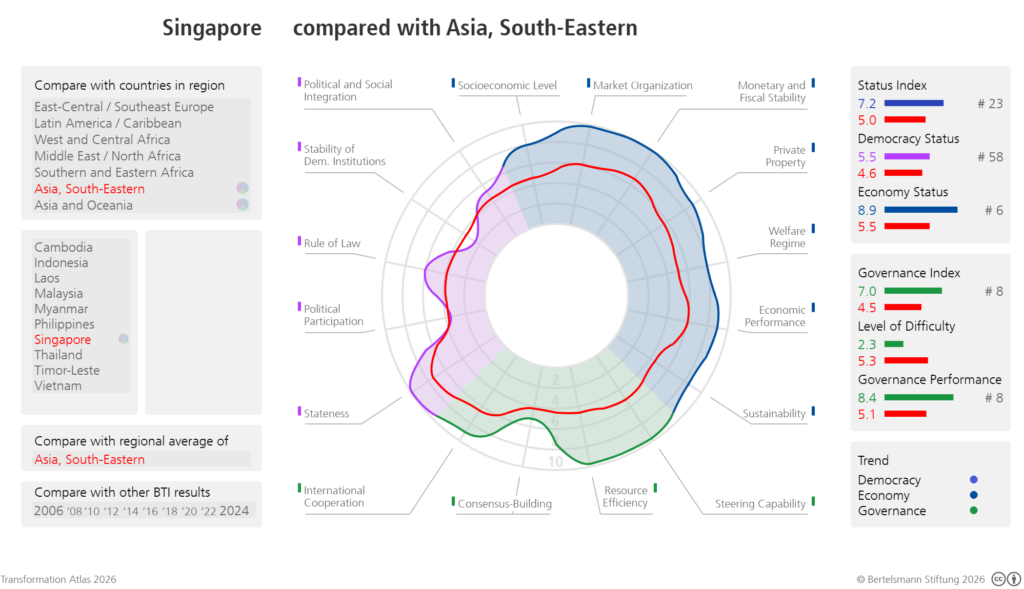
Singapore consistently rates as the most political stable country in not only Southeast Asia, but within Asia itself.
Source: Transformation Atlas 2026

2. Competitive Tax System
Singapore has consistently ranked first as the most competitive tax system in the world. Businesses in Singapore may enjoy the following:
- Low flat corporate income tax rate at 17%
- No tax imposed on capital gains
- No dividend tax for shareholders
- Extensive tax incentives and exemptions for start-ups, SMEs, and regional headquarters, where start-ups may receive up to 75% exemption off their first SGD100,000 of normal chargeable income, and SMEs can continue to receive partial tax exemption even after their start-up phase.
While neighbouring countries may offer lower headline tax rates or tax holidays, these often come with extensive conditions, inconsistent interpretations, or higher compliance costs. Singapore’s taxation system is not only competitive; it is transparent and straightforward.

3. Highly skilled and diverse talent pool
Singapore is the 1st in Asia and 2nd worldwide in English proficiency, with an 97.6% adult literacy rate. Singapore’s bilingual education policy also ensures that local talent is proficient in English and at least one other Asian language, such as Mandarin, Bahasa Melayu or Tamil. This opens efficient communication across Southeast Asian markets from one central hub and management.
The Singapore government invests heavily in nationwide skills development initiatives to ensure that their workforce keeps up with changes in the global economy. To date, nearly S$1 billion has been invested in the national upskilling programme SkillsFuture, with Singapore Prime Minister and Minister for Finance Lawrence Wong pledging to continuous investment.

4. Future Forward Initiatives
In 2014, Singapore launched the Smart Nation initiative, driven by a compelling vision: to build better, meaningful, and fulfilled lives for people, enabled by technology. Automated immigration, smart parking, autonomous mobile robots, the employment of drones for inspection, 5G network, smart solutions for urban sustainability, the Singapore National AI Strategy (NAIS) etc, the Singapore government is continuous investing in a future forward Singapore. The Research, Innovation and Enterprise (RIE) 2030 plan allocates over S$37 billion to supporting the research and development of multiple sectors, including technology. The Open Innovation Platform connects corporates, entrepreneurs, innovators and researchers to co-develop and testbed solutions for real-world problems.
On top of that, Singapore has always been the leading data centre hubs, with around 1.4 gigawatts of computing power. Recently, Singapore announced plans to tighten data centre rules, which prioritises efficiency. “For Singapore, a country that doesn’t have a lot of land, using a chip that is 50 times more energy efficient than its predecessor really democratises data centre space.”
It is easy to look at short-term effects, but to nurture a powerful tree, one needs stable roots and environment. Choosing Singapore as a business hub for Southeast Asia expansion provides years of nurtured stability, along with modern, future facing prospects, which is rarer now in these global conditions.
At Zero-Ten Park Singapore, we offer various office plans tailored to any stage of business:
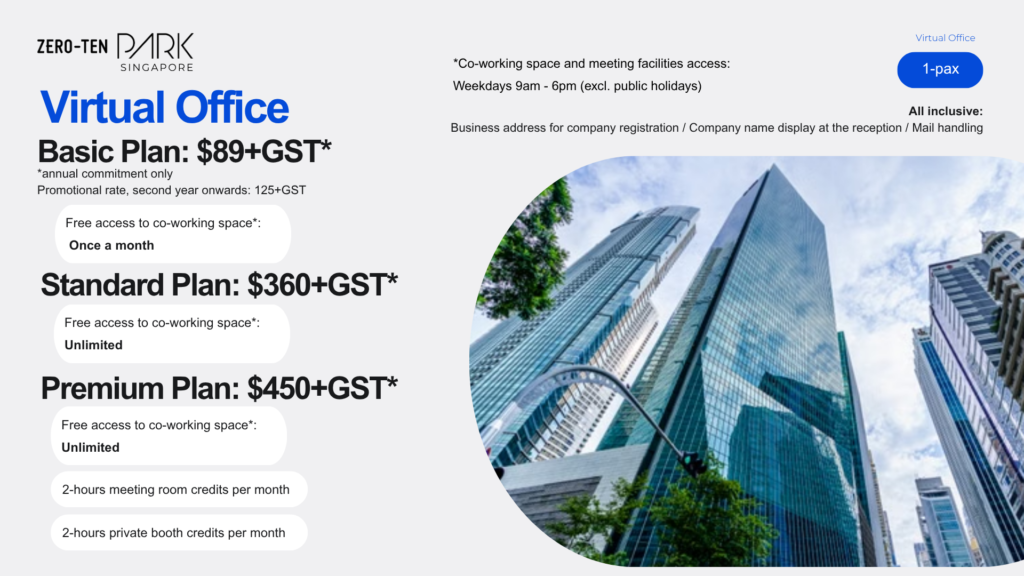
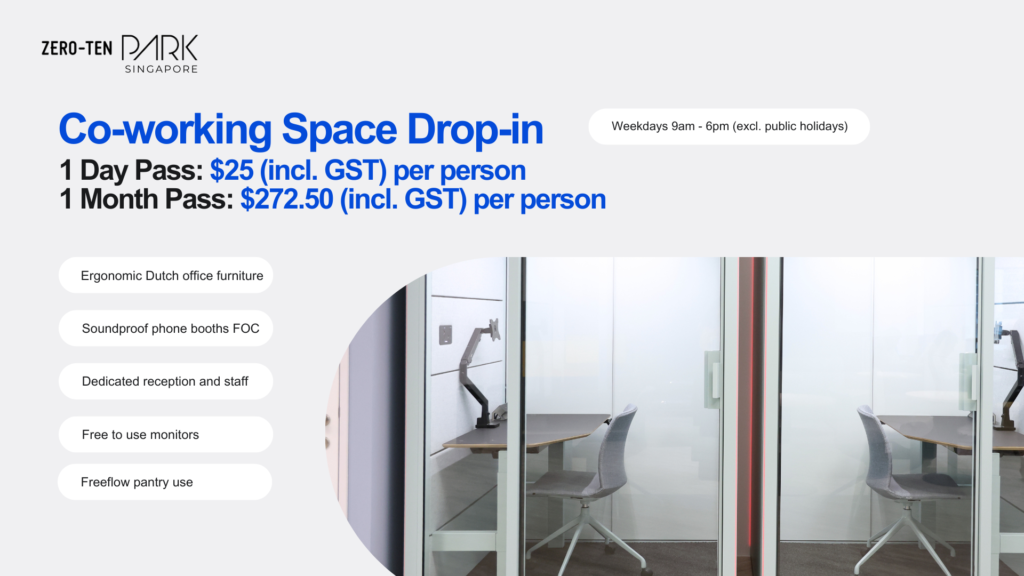
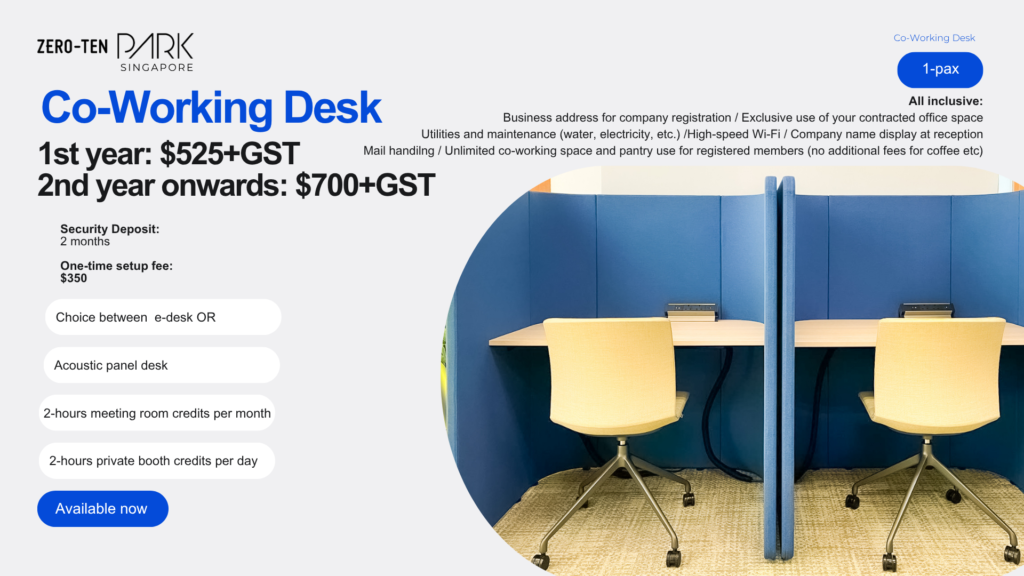
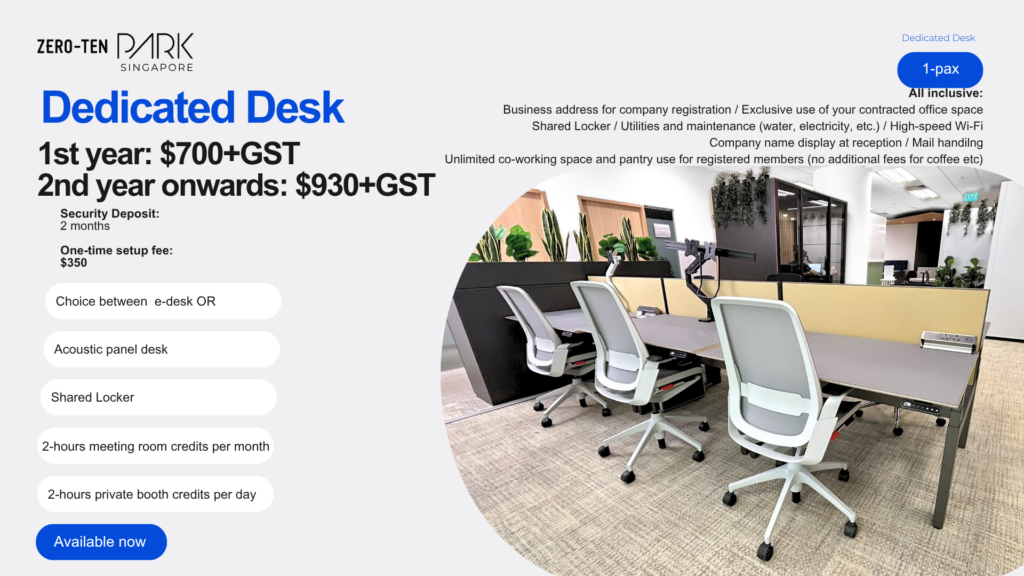
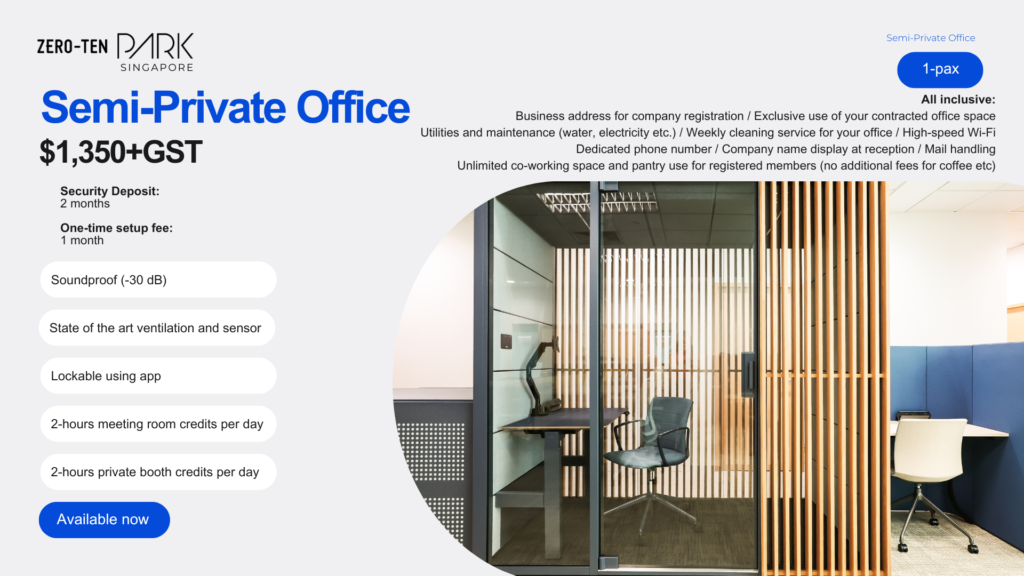
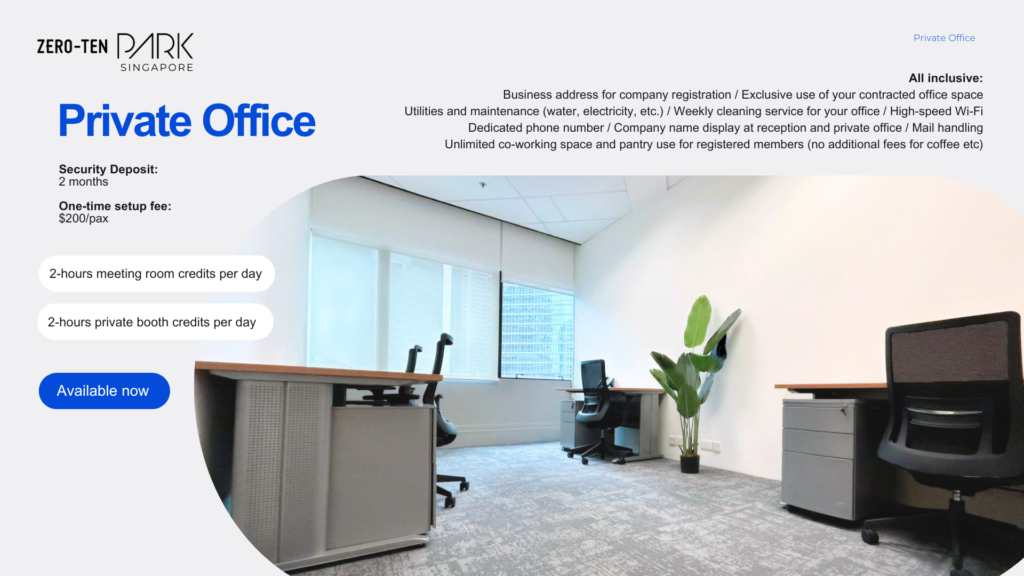
Looking for an office? Contact us today and find out how we can help your business grow.
The information provided on this column is for general informational purposes only. The opinions expressed in this column are those of the authors and individual experiences shared to the authors, and do not constitute professional advice and may not reflect the industry as a whole. Users are responsible for how they choose to use the information provided.
The authors and organisation assume no responsibility or liability for any errors or omissions in the content of this site. The information contained in this site is provided on an “as is” basis with no guarantees of completeness, accuracy, usefulness or timeliness. Any content provided by our contributors or guest authors is their own and does not represent the views of our organisation.
We are not responsible for any losses, damages, or liabilities that may result from the use of this column or reliance on its content.
We reserve the right to prohibit access, use, conduct, communications, or content that we, in our sole discretion, deem to be harmful to the site, users, us, our brand, our business partners and licensors, or any other person or entity, or that violates these Terms of Use and/or applicable law.
For Viewings・Inquiries
Zero-Ten Park Singapore accepts requests for viewing and inquiries at any time!
Please feel free to contact us by phone or via the inquiry form below.
TEL :+65-6420-6370
Whatsapp :+65-9852-4360
※Staff availability hours are 9:00-18:00 on weekdays (excluding Singapore public holidays and office closures).
Getting Here
Zero-Ten Park Singapore is located on Robinson Road in the heart of Singapore’s Central Business District (CBD) within walking distance of major stations.
A bus stop is also located right in front of the building, allowing you to commute to work without being at the mercy of the weather.
Address
80 Robinson Road #10-01A Singapore 068898
Google Maps
Getting Here – MRT(Underground)
Telok Ayer Station 3 minute’s walk Nearest station
Raffles Place Station 4 minute’s walk
Tanjong Pagar Station 7 minute’s walk
Shenton Way Station 5 minute’s walk
Getting Here – Bus
80 Robinson Rd (B03071) Stops directly in front of the building
Social Media



Zero-Ten Park Singapore: Connect, Create, Thrive